


Replacing a missing tooth is important not only for the appearance of your smile but also for chewing, speaking, and maintaining the balance of your teeth.
Two common solutions for replacing missing teeth are dental implants and dental bridges. Both can restore the appearance and function of your smile, but they work in very different ways.
So, which option is right for you?
The answer depends on several factors, including your oral health, bone condition, the health of your neighboring teeth, your treatment goals, and your personal preferences.
What Is a Dental Implant?
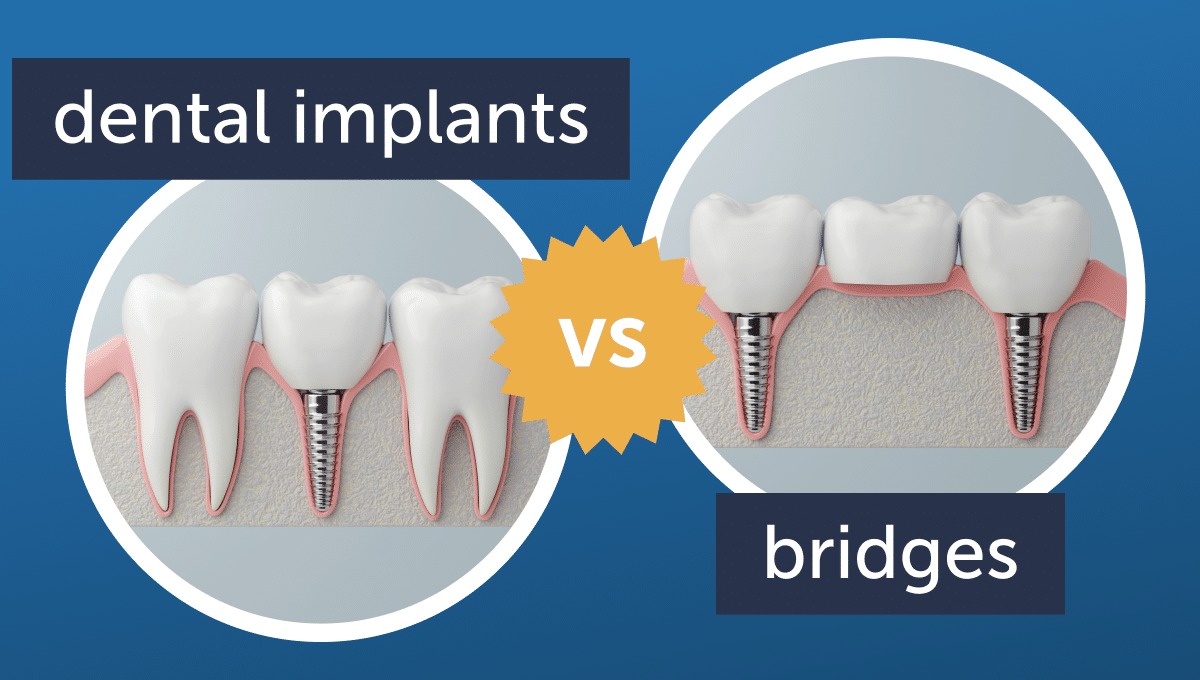
A dental implant is a replacement for the root of a missing tooth. It is placed into the jawbone and, after healing, supports a dental crown that replaces the visible tooth.
Because the implant is anchored in the jawbone, it does not depend on neighboring teeth for support.
Dental implants can be used to replace a single missing tooth or as part of a larger treatment plan for multiple missing teeth.
What Is a Dental Bridge?
A dental bridge is a fixed restoration used to replace one or more missing teeth.
A traditional dental bridge typically consists of an artificial tooth supported by crowns attached to the neighboring teeth.
Unlike an implant, a traditional bridge does not replace the missing tooth root. Instead, it relies on the surrounding teeth for support.
Dental Implants vs. Bridges: The Main Differences
1. How They Are Supported
Dental implants are anchored directly into the jawbone and act as an artificial tooth root.
Traditional bridges are supported by neighboring teeth.
This fundamental difference can influence which treatment is more appropriate for an individual patient.
2. Effect on Neighboring Teeth
One advantage of a single dental implant is that it can replace a missing tooth without requiring the neighboring healthy teeth to support the restoration.
With a traditional bridge, the supporting neighboring teeth generally need to be prepared to accommodate the crowns that hold the bridge in place.
3. Bone Preservation
When a natural tooth is lost, the bone surrounding the missing tooth can gradually decrease over time.
Because an implant is placed into the jawbone and functions as an artificial tooth root, it can help maintain the bone in that area.
A traditional bridge does not replace the missing root, so it does not provide the same type of stimulation to the jawbone.
4. Treatment Time
A dental bridge can often be completed more quickly because it does not require the same bone-healing process as an implant.
Dental implant treatment usually involves a healing period during which the implant integrates with the jawbone. The overall treatment timeline depends on the individual case and whether additional procedures are required.
5. Durability and Maintenance
Both implants and bridges can provide long-term tooth replacement when properly planned and maintained.
Dental implants are designed as a long-term solution, while bridges may eventually require replacement due to wear, damage, or changes affecting the supporting teeth.
Good oral hygiene and regular dental examinations are important for both treatments.
Which Option Looks More Natural?
Both dental implants and bridges can be designed to provide an attractive and natural-looking result.
The final appearance depends on factors such as the quality of the restoration, tooth shape, color, proportions, gum position, and the overall smile design.
A well-designed implant crown can closely replicate the appearance of a natural tooth because it emerges from the gum similarly to a natural tooth.
A bridge can also provide an excellent aesthetic result, particularly when carefully matched to the surrounding teeth.
Which Treatment Is More Comfortable?
Both treatments are designed to function comfortably once completed.
An implant may initially involve a surgical healing period, while a bridge typically does not require implant surgery.
The most comfortable option depends on the individual patient, the condition of the teeth and gums, and the complexity of the treatment.
Are Dental Implants Better Than Bridges?
Not necessarily.
Dental implants offer several advantages, particularly when the neighboring teeth are healthy and there is sufficient bone to support an implant.
However, a bridge may be a very appropriate solution in certain situations, especially when the neighboring teeth already require crowns or when implant treatment is not suitable.
The goal is not to choose the most advanced treatment—it is to choose the treatment that is most appropriate for your specific dental situation.
When Might a Dental Implant Be Recommended?
An implant may be considered when:
- A single tooth is missing
- The neighboring teeth are healthy
- There is sufficient bone to support an implant
- The patient wants a fixed, independent tooth replacement
- The patient is suitable for implant surgery
A detailed examination and appropriate imaging are necessary before treatment.
When Might a Dental Bridge Be Recommended?
A bridge may be considered when:
- The neighboring teeth can appropriately support the restoration
- A faster treatment timeline is preferred
- The patient is not a suitable candidate for an implant
- The supporting teeth already require crowns or significant restoration
- A bridge is considered the most appropriate option for the patient’s specific case
How Do You Choose Between an Implant and a Bridge?
The decision should be based on a comprehensive dental assessment rather than appearance alone.
Your dentist may evaluate:
The condition of your neighboring teeth
The amount and quality of available bone
The health of your gums
Your bite and chewing forces
Your overall oral health
Your aesthetic goals
Your desired treatment timeline
Your long-term expectations
At Dr. Joe Karam’s clinic, each case is individually assessed to determine the most appropriate solution for replacing missing teeth, with attention to both function and aesthetics.
Frequently Asked Questions
- Is a dental implant stronger than a bridge?
Dental implants are anchored into the jawbone and can provide a stable foundation for a replacement tooth. However, both implants and bridges can function effectively when properly planned, placed, and maintained. The best option depends on the individual case.
- Which is better for healthy neighboring teeth: an implant or a bridge?
A single implant can replace the missing tooth without using the neighboring teeth for support. A traditional bridge generally requires the neighboring teeth to support the restoration. Your dentist can determine which approach is most appropriate after examining your teeth and gums.
- How long do dental implants and bridges last?
Both can provide long-term solutions, but their longevity varies depending on oral hygiene, bite forces, gum health, the quality of the restoration, and regular dental care. The implant itself can potentially remain functional for many years, while a bridge may eventually need replacement.
- Can I get a dental implant instead of a bridge?
In many cases, yes. However, suitability depends on factors such as bone availability, gum health, overall oral health, and your individual treatment plan. A dental examination and appropriate imaging are necessary to determine whether an implant is a suitable option.
Final Thoughts
Both dental implants and bridges can successfully replace missing teeth and restore your smile. The difference is in how they are supported, how they interact with neighboring teeth, the treatment process, and their long-term considerations.
There is no single solution that is right for every patient.
A professional consultation allows your dentist to evaluate your teeth, gums, bone, bite, and aesthetic goals and recommend the treatment that best suits your individual needs.
The best tooth replacement is not simply the one that looks good today—it is the one that supports your oral health and smile for the future.